
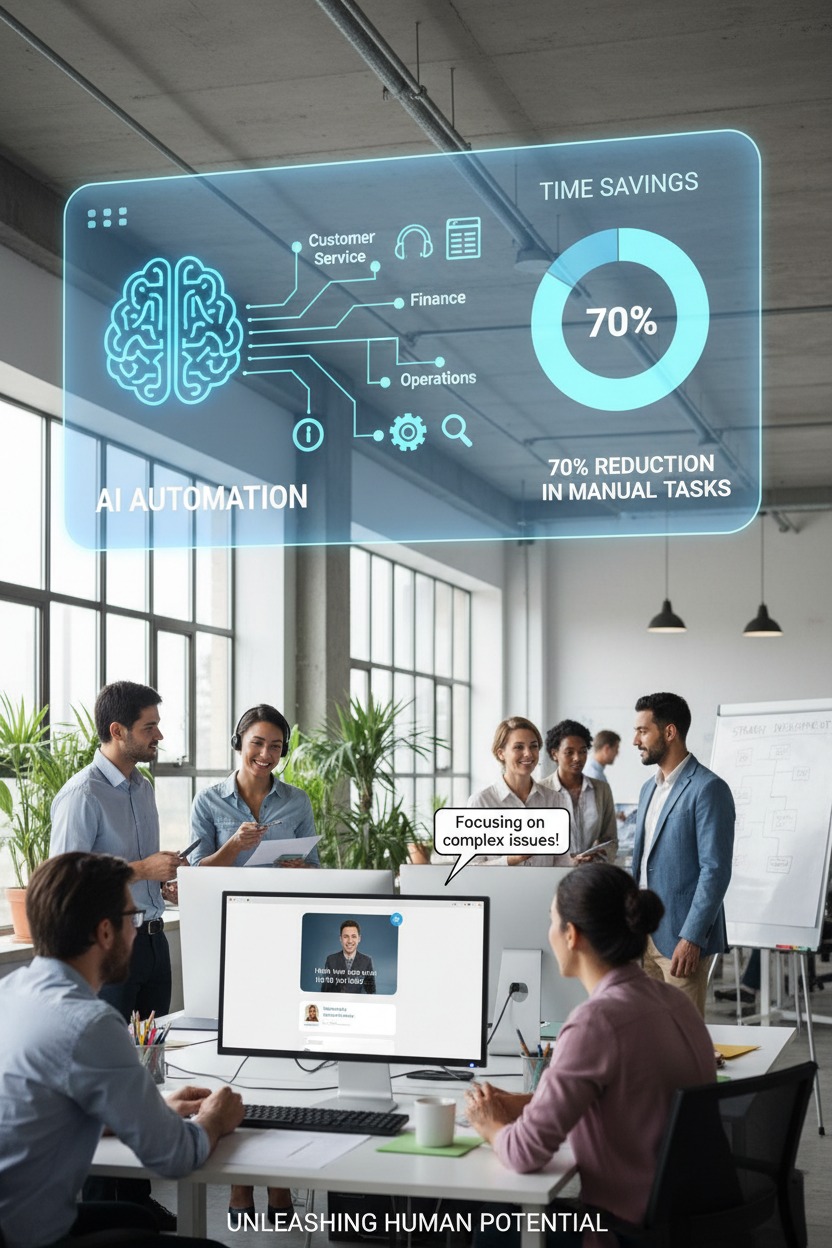
A company optimized daily tasks and achieved significant cost savings by leveraging Artificial Intelligence (AI) tools to automate repetitive processes, enhance decision-making, and improve operational efficiency. By strategically integrating AI into its workflows, the company was able to reduce operational costs, boost productivity, and position itself for sustainable growth.
The company used AI to automate a wide range of time-consuming, manual tasks across various departments, freeing employees for more strategic work. Specific applications included:
- Automated Accounting: The finance team implemented AI-powered robotic process automation (RPA) tools that process thousands of invoices, reconcile accounts, and input data with near-perfect accuracy. This dramatically reduced manual errors and accelerated financial reporting cycles.
- Enhanced Customer Service: AI-powered conversational agents and chatbots were deployed to handle a significant portion of customer inquiries 24/7. These tools provided instant responses, reducing customer wait times and lowering the workload of human agents, with some companies reporting a 30% reduction in help desk costs.
- Optimized Resource Allocation: The operations department used AI and machine learning models to analyze workflows and resource allocation, identifying inefficiencies and optimizing the use of assets without increasing headcount.
Streamlining Daily Operations
Realizing Significant Cost Savings
The company’s smart use of AI resulted in substantial financial benefits. Key areas of savings included:
- Reduced Operational Costs: The company saw a significant reduction in operational expenses, consistent with industry reports suggesting that companies adopting AI and automation solutions can reduce operational costs by 20–30%.
- Increased Productivity: Generative AI tools led to an average performance improvement of 66% for certain tasks, allowing the company to scale operations without requiring significant infrastructure investments.
- Improved Accuracy and Fraud Detection: Machine learning algorithms monitored transactions in real-time for anomalies, flagging potential errors or fraud before they could escalate and minimizing financial losses.
A Foundation for Future Growth
The implementation of AI provided a strong financial and operational foundation, transitioning the company from reactive, “look-back” analysis to proactive, data-driven decision-making. The ability to simulate varied business scenarios and adjust to real-time market changes allowed the company to manage risk more effectively and capitalize on new opportunities. This increased organization, control, and efficiency positions the company for sustainable growth, demonstrating that leveraging the right AI tools is a strategic investment in innovation and future success.